Most companies have someone who fixes technology. Few have someone who advises on it. Performance Connectivity, Inc. (PCI) is the advisor at the table — translating what’s technically possible into what’s worth doing for your revenue, your risk, and your operations. Some firms call this a vCIO. We call it doing the job right.
Performance Connectivity, Inc. (PCI) is a technology advisory firm in Purchase, NY, serving Westchester County and Fairfield County businesses since 1997. We’re the advisor at the table — translating what’s technically possible into what’s worth doing for your revenue, your risk, and your operations, on your side of the table with no product to sell. The same partner advises you year after year, so the judgment compounds instead of resetting every time a vendor rotates through.
A vendor pushes a product. Someone signs off on a $40,000 rollout. Nobody in the room can say what problem it solves — or whether it solves one at all.
That’s a governance problem. It’s what an actual advisor prevents: not by knowing more acronyms, but by asking the one question the room forgot — what is this for, and is it worth it?
Every recommendation ties back to a number you care about — revenue enabled, risk reduced, hours returned. If it doesn’t move one of those, it doesn’t get recommended.
Internet, cloud, zero trust, now AI — we’ve moved clients through each one early, before it became a crisis. You hear about the shift while there’s still time to plan for it.
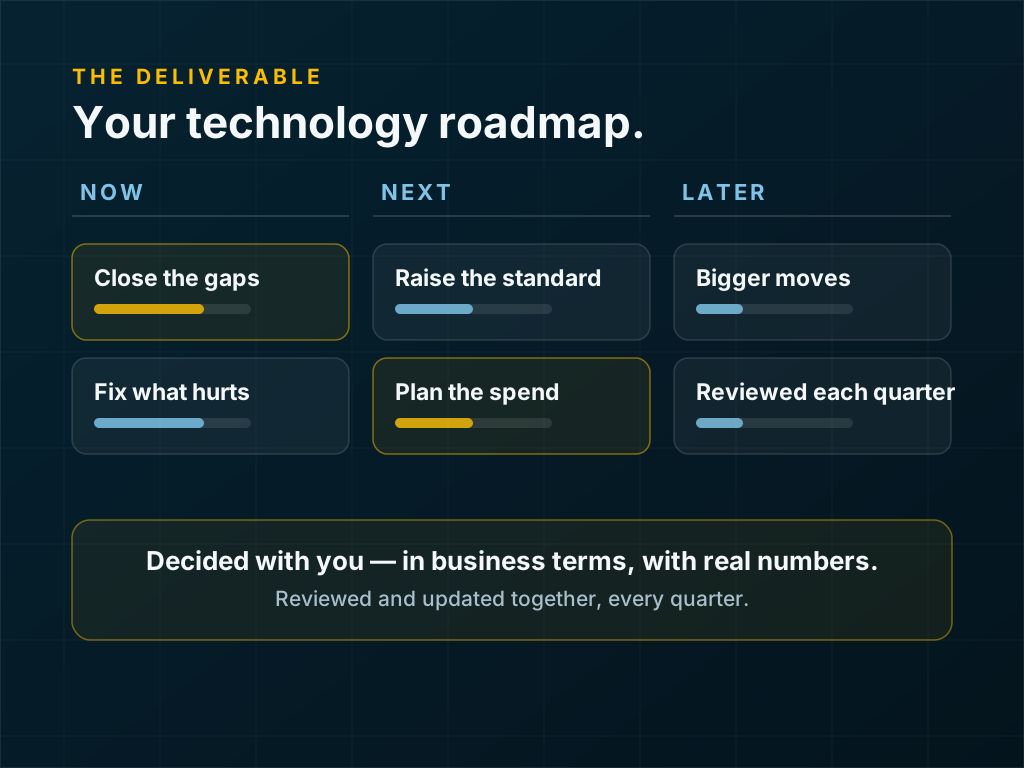
Not a stack of one-off quotes, but a plan with sequence and reasoning — what to do now, what to wait on, and why each piece comes when it does.
No product to move, no quota to hit. The advice is the same whether you buy anything or not — because our job is the read, not the sale.
Three steps. The same discipline behind every engagement.
Your technology environment and your business: what you run, what it exposes you to, and where it holds you back.
Into revenue, risk, and operations. No jargon, no 60-page report — just what it means for the business.
Together, what’s worth doing and what isn’t. A straight read, not a pitch.
The owner, the CEO, the CFO — whoever has to stand behind a technology decision to a board, a bank, or themselves.
You don’t want a demo and a discount. You want a straight answer first: is this worth doing, what does it actually cost us to get wrong, and what would you do if it were your money? That’s the conversation we’re built for.
A partner who has done this since 1997 — the same person, year after year. No account-manager churn, no junior handoff, no starting over every time your point of contact moves on. The relationship is the product, and it compounds.
Est. 1997 · Purchase, NYHow the engagement starts — described, not promised. Three moves, in the order they happen.
It starts as a conversation, not a sales call — bring the decision you’re weighing or the problem that keeps resurfacing. Then we read the environment: what you run, what it exposes you to, and where it holds you back. We map what’s there before we touch anything.
What we find gets documented, and the documentation belongs to you. No black box, no hostage situation — the read is yours to keep, whatever you decide to do with it.
Then we translate and decide together — a straight read on what’s worth doing and what isn’t: what to do now, what to wait on, and why each piece comes when it does. If we take over the day-to-day, the transition runs in parallel and cuts over quietly — the full approach is in switching IT providers without the horror story.
The thinking behind this way of working has a name — read What is the Interpretation Economy?
One keeps the lights on; the other tells you which decisions are worth making. Plenty of firms fix what breaks. Far fewer sit on your side of the table and translate what is technically possible into what is actually worth doing for your revenue, risk, and operations. PCI is the advisor in the room where the decision gets made, not just the vendor you call afterward.
A senior advisor who connects every technology decision to a number you care about, reads the shifts coming before they become a crisis, owns a roadmap with sequence and reasoning, and gives you a straight read whether or not you buy anything. The relationship is the product — the same partner, year after year, not a rotating account manager.
A vendor has a product to move and a quota to hit. We do not. The advice is the same whether you buy anything or not, because our job is the read, not the sale. That is why the person defending a technology decision to a board, a bank, or themselves wants an advisor in the room, not another pitch.
We do not publish a flat rate, because the right amount of advisory depends on the decisions in front of you and the size of what is at stake. The structure is simple to explain, and one conversation is enough to scope it to your firm. Bring the decision you are weighing and we will tell you what we would actually do.
Because most providers can tell you how, but not whether. An advisor is the one who asks the question the room forgot — what is this for, and is it worth it — before someone signs off on a rollout nobody can defend. If we also take over the day-to-day, the advice and the execution finally answer to the same person.
It starts as a conversation, not a sales call — bring the decision you are weighing or the problem that keeps resurfacing. Then we read the environment, document what we find (the documentation is yours), and translate it into a roadmap: what to do now, what to wait on, and why. If we take over day-to-day IT, the transition runs in parallel and cuts over quietly.
On the ground across Westchester County, NY and Fairfield County, CT.
From the Insights desk: What does a vCIO do — and does a 25-person firm need one?
Bring the decision you’re weighing. We’ll tell you what we’d actually do.