The goal isn’t to scare you into buying tools. It’s to manage a real business risk with a clear head. Performance Connectivity, Inc. (PCI) defends the threats that actually target companies your size — and explains them in language you can carry into your own leadership meeting.
Performance Connectivity, Inc. (PCI) is a managed IT and cybersecurity firm in Purchase, NY, treating security as risk management for Westchester County and Fairfield County businesses since 1997. We defend the whole environment as one — identity, endpoints, access, and the forgotten device that lets attackers in — and keep your posture documented and defensible for insurers, banks, and clients. Just the threats that actually target firms your size, managed with a clear head.
Ransomware groups run like companies. They have payrolls, playbooks, and quotas. They scan the internet at scale, looking for the target of opportunity — one unprotected asset, one old device nobody was watching.
So the question was never whether you’re interesting enough to attack. It’s whether you’re an easy door. That reframe changes everything about how you defend.
They rarely kick down the front door. They slip in through something forgotten — an old VPN nobody decommissioned, an unmonitored machine in a back office, a login that should have been shut off months ago.
Then they move sideways. Security people call it lateral movement: quietly hopping from that first foothold to the next, and the next, until they reach something that actually matters — your files, your finances, your backups.
You stop it by deciding, in advance, what’s allowed to talk to what. Most breaches aren’t a failure of tools. They’re a failure to have made that decision.
Anyone can buy security products. Fewer can tell you whether they’re actually reducing your risk — the same gap our IT relationship scorecard helps you measure. Here’s how we think about it.
Deny by default. Nothing on the network is trusted just because it’s inside. We decide what’s allowed to talk to what — and everything else is off the table.
The forgotten machine is the one that lets them in. We watch the entire environment as a whole — not a handful of devices someone remembered to protect.
The person is the target, not just the laptop. Protection follows the user across the devices and accounts they actually use, wherever the work happens.
Owning tools isn’t the same as managing posture. Someone has to keep the settings right, the coverage complete, and the gaps closed as things change. That’s the work.
Increasingly, your carriers, your banks, and your partners ask a version of the same question: what do you protect, and can you prove it? A strong security posture is what lets you answer with a straight face.
So we account for it. We keep your posture defensible — documented, consistent, ready to show — so those questions don’t become emergencies. If regulation is driving the conversation, our guide to IT compliance for Westchester and Fairfield firms covers what examiners and carriers actually ask.
But compliance is a consideration we build around, not the reason we recommend anything. We defend your business because the risk is real, and we make sure the defensible paperwork follows. Not the other way around.
Plenty of firms will sell you tools and wish you luck. We take responsibility for the posture. If something gets through, we remediate — we don’t turn around and bill you for the incident we were hired to prevent.
That’s one line of accountability, and a partner’s name is behind it. It’s the difference between a vendor and an advisor who has to live with the outcome.
Est. 1997 · Purchase, NYYes — not because you are a marquee name, but because attackers scan the whole internet for easy doors, not famous ones. Ransomware groups run like businesses hunting the least-defended target of opportunity. The question was never whether you are interesting enough to attack; it is whether you are easy to get into.
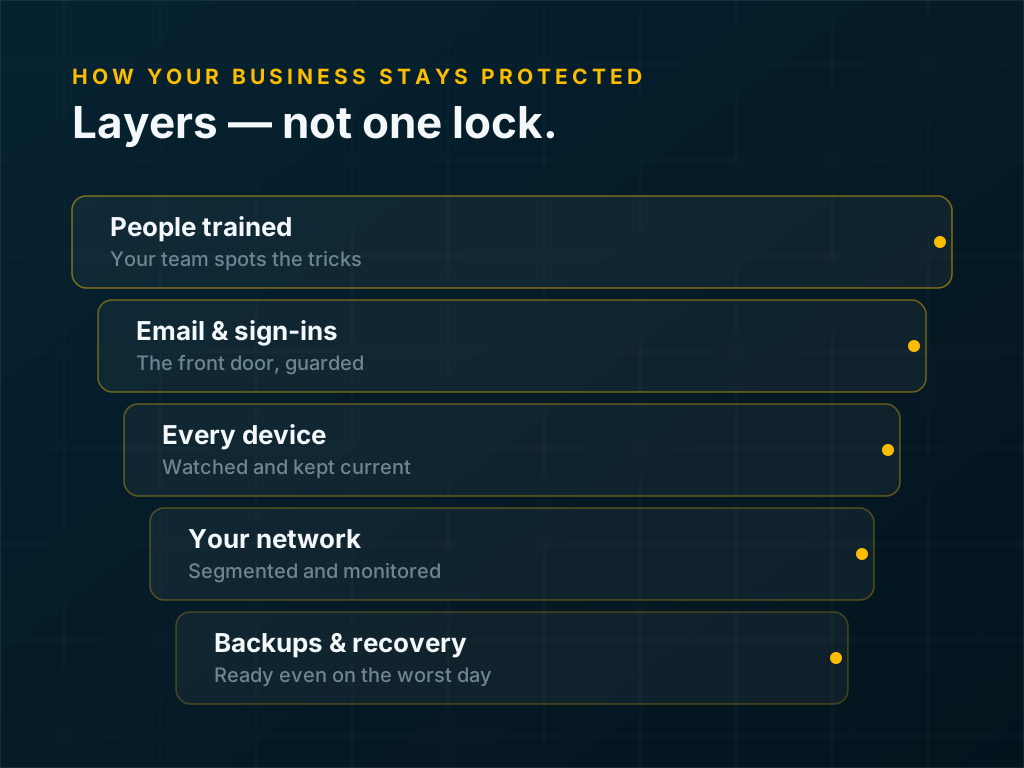
The whole environment defended as one: identity and access hardened, every device and login monitored — not just the ones someone remembered — decisions made about what is allowed to talk to what, and the posture kept current as things change. Owning security tools is not the same as managing posture, and the ongoing work is the point.
We do not publish flat rates, because a ten-person advisory firm and a fifty-person practice carry very different risk and very different environments. The structure is simple to explain, and one conversation is enough to scope a real number to your firm — what is covered, what is separate, and what it costs.
Usually, yes. Insurers now ask pointed questions before they renew — multi-factor authentication, tested backups, endpoint protection, access controls — and a managed security posture is what lets you answer them honestly instead of guessing. We keep the evidence documented and ready, so a renewal application is not a fire drill.
Yes. Clients, banks, and examiners increasingly ask a version of the same question — what do you protect, and can you prove it. We keep your posture documented, consistent, and ready to show, whether the framework in question is SHIELD, Reg S-P, NYDFS, SOC 2, HIPAA, or CMMC. Compliance is a consideration we build around, never the reason we recommend something.
We remediate — we do not hand you an invoice for the incident we were hired to prevent. One firm owns the posture, and a partner's name is behind it, so there is no finger-pointing between vendors while your business is down. That single line of accountability is the difference between a tool seller and an advisor who has to live with the outcome.
On the ground across Westchester County, NY and Fairfield County, CT.
We’ll give you an honest read on where your real exposure is.