Managed IT · Westchester NY & Fairfield CT

The tickets that sit. The bill you can’t explain. The setup nobody documented.

If any of that sounds familiar, it’s usually why someone reads a page like this. Here’s the turn: managed IT done properly makes those problems structurally impossible — not because someone works harder, but because one firm owns the whole environment, watches it day to day, and writes it all down. Performance Connectivity, Inc. (PCI) has run it that way, owner to owner, for coming up on 30 years. Here’s what that looks like.

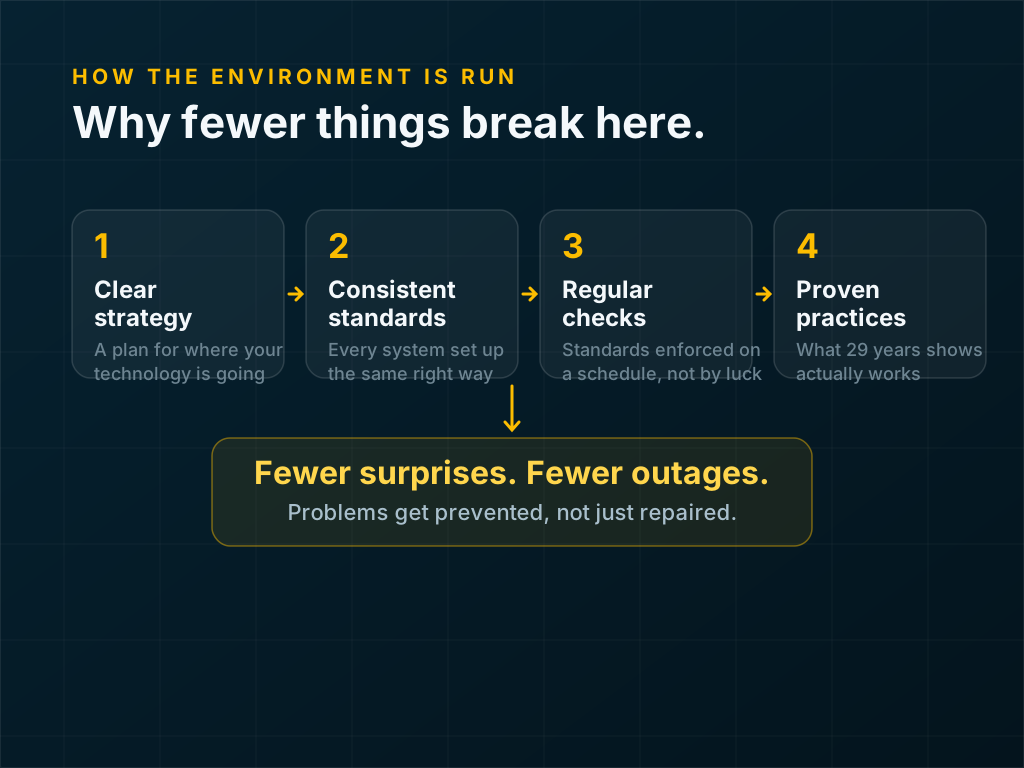
Four steps - clear strategy, consistent standards, regular checks, proven practices - leading to fewer surprises and fewer outages

Performance Connectivity, Inc. (PCI) is a managed IT and technology advisory firm in Purchase, NY, providing managed IT services to Westchester County and Fairfield County businesses since 1997. One firm owns your whole environment — monitoring, maintenance, security, backup, and support — under a fixed monthly agreement, with a senior advisor connecting it to revenue, risk, and operations. Same three partners, still owner-run, coming up on 30 years.

Old model vs. ours

We left the fire-department model behind.

Break-fix works like a fire department: something burns, they put it out, nothing changes, and it burns again. You pay per fire, and the fires keep coming.

We moved to managed, monitored IT years ahead of the market — because watching an environment and maintaining it beats waiting for it to fail. The difference isn’t more visits. It’s fewer fires.

23% of businesses that leave an IT provider leave over support — tickets that sit, problems that come back. (JumpCloud SME IT Trends, 2024)

What we take on

We assume responsibility for the environment.

Not a stack of tickets — the whole environment, and one name behind it.

The whole stack, one owner

Machines, network, servers, cloud — held together as a single environment, not a pile of disconnected parts. When something’s off, one firm owns the answer.

Watched, not just installed

Setting up hardware is the easy part. We keep an eye on the environment day to day, so small problems get handled before they become the reason nobody can work.

Documented and portable

Your environment is written down and belongs to you — no hostage situation. If you ever leave, you leave with everything. That confidence is the point.

On-site when needed

Most things get handled remotely. When a problem needs hands on it, someone comes — Purchase, NY, and the surrounding area — with no surcharge for showing up.

Day to day

What this looks like on a Tuesday.

Tickets get answered by people who already know your environment — not a stranger reading a script for the first time. It’s the same responsive IT support we bring to every help-desk request.

A new hire is ready on day one: account, machine, access, all set before they sit down. And last year’s break doesn’t come back, because we fixed the cause, not just the symptom.

It’s boring, in the best way. That’s what managed IT is supposed to feel like.

Protection

We protect the user, not just the device.

A laptop is replaceable. The person using it — their access, their identity, their work — is the thing worth protecting. So support and protection follow the person, wherever they work from.

The person, not the hardwareSupport follows the user across whatever device they’re on — office, home, or the road. Swap the machine, the protection stays.
Identity is the real perimeterThe login is what an attacker wants. We guard identity and access, because that’s where the environment is actually defended.
One point of contactWhen a user has a problem, they reach people who know them and their setup — no queue, no re-explaining it from scratch.
Why it holds up

Reliability is a byproduct of continuity.

The reason things run quietly isn’t a single tool — it’s the same firm, watching the same environments, for a very long time. Same owners since 1997. We know what your setup looked like last year, and the year before, and why. That memory is what keeps the fires from starting.

Est. 1997 · Purchase, NY
Switching to PCI

Changing IT providers, without the horror story.

Most of the dread around switching comes from how it’s usually done. Here’s how we do it instead — and a fuller walk-through of switching IT providers without the horror story.

If you’re comparing managed service providers (MSPs) in Westchester, ask each one who actually owns the outcome.

What does the first 30 days of switching look like?

A full read of your current environment before we touch anything — we map what you have, because you can’t move what you haven’t understood.

Who owns the documentation when we switch?

You do. Your setup gets written down and stays portable. No hostage situation, no black box only we can read.

We move in parallel and cut over quietly

The old setup keeps running while we build the new one alongside it. The goal is a normal Tuesday, not a disruption.

We handle the handoff

You don’t referee the conversation with your old provider. We manage the transition so it lands on us, not you.

Straight answers

Straight answers to fair questions.

How does PCI price managed IT?

We don't publish rates, because two 30-person firms rarely have the same environment. But the structure is simple to explain, and one conversation is enough to give you a real number scoped to your firm — what's covered, what's separate, and what it costs.

Should a 30-person firm outsource IT or hire someone in-house?

At 30 people you need pieces of four different specialties — help desk, security, cloud administration, and strategy — but not a full-time load of any of them. One internal hire can't cover that spread, and a good one costs more than a managed agreement. Below roughly 75 employees, a managed provider with a real advisory layer usually wins; past that, a hybrid starts to make sense.

What's included in PCI's managed IT service?

The whole environment under one owner: monitoring and maintenance of every device and system, security across users and endpoints, backup, vendor management, on-site work when it's needed, and documentation that belongs to you. Plus the part most providers skip — a senior advisor connecting it all to revenue, risk, and operations.

Does PCI only work with businesses in Westchester?

PCI is built around Westchester County, NY and Fairfield County, CT — Purchase, White Plains, Rye, Stamford, Greenwich — but clients now reach across the country. Local roots, national reach, one continuous team behind both.

How fast does PCI respond when something breaks?

Fast, because the person who picks up already knows your environment — no time lost re-explaining your setup to a stranger. Urgent problems get treated as urgent, and you reach people who can actually fix the thing, not just log a ticket that ages in a queue. Continuity is what makes that speed possible: the same firm has watched the same environments for years.

Are we locked into a long contract with PCI?

There are no trap-door terms designed to make leaving painful. The relationship holds because the work is good, not because a contract traps you. Your environment is documented and portable, so if you ever left, you would leave with everything — which is exactly why most clients stay.

Who actually shows up when we call PCI?

People who already know you and your setup — not a rotating queue of strangers reading a script. The same firm has run this the same way, under the same three partners, since 1997, so the person on the phone has context most providers lose to turnover. When a problem needs hands on it, someone comes on-site across Purchase and the surrounding Westchester and Fairfield area.
Where we deliver this

On the ground across Westchester County, NY and Fairfield County, CT.

Let’s talk

Where does it break for you?

Tell us where it breaks. We’ll tell you why, and what we’d do.

30 Years — coming in 2027